admin
Amazon’s Ring Robotics division is moving into autonomous mobile security with the Tuesday announcement of its drone and roving cams.
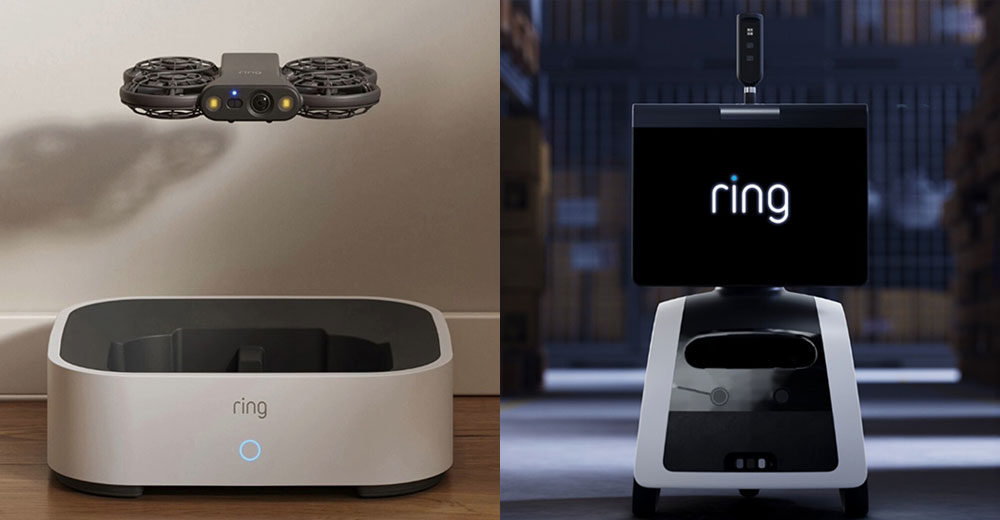
The Ring Drone Cam (US$249.99) is a flying indoor security camera that can check on different rooms in a home. Amazon expects it to begin shipping in the U.S. on Jan. 27, 2027, pending FCC authorization.
The Ring Rover Cam ($999.99) is a security robot that can autonomously patrol business premises and investigate disturbances. It’s available for preorder and is scheduled to begin shipping in the U.S. on Dec. 16.
AI Pilot, a custom-built system that maps spaces, suggests patrol points, and navigates around obstacles, is the brains behind both devices.
„For years, customers told us they wanted eyes in the places a fixed camera couldn’t reach, and peace of mind in the spots they’d never want one,” Jamie Siminoff, Ring’s founder and chief inventor, explained in a statement.
„The honest answer wasn’t more cameras,” he continued. „It meant reimagining what a security device could be.”
„That kind of invention is hard, and it takes time,” he said. „But we kept at it until we got it right….”
„It’s not just a new category of security,” he added. „It’s the beginning of a future where proactive, autonomous protection is something every home and every business can have.”
Guard Who Never Clocks Out
The Ring Drone’s camera is built from the ground up with artificial intelligence at its core, according to Amazon. The camera has a 148-degree field of view and rotates 360 degrees, providing a whole-room view in 2K video that can be captured even in low-light conditions, thanks to two built-in LED lights that activate automatically.
The drone can be deployed manually. When a Ring camera, sensor, or alarm is triggered, the drone automatically flies to preset patrol points.
The Ring Rover can be sent to any room or patrol point in a business to investigate disturbances. Once it arrives, it performs a 360-degree scan. A compatible Ring Protect plan is required to schedule drone flights or Rover patrols.
The unit has a periscope camera, so it can see over counters, shelving, and obstacles, plus a built-in siren and light tower to show an area is protected. It also has two-way audio.
The Rover records continuously in up to 4K throughout a patrol, including between designated stops.
It’s like having a guard on patrol who never clocks out, Amazon said.
Raccoon or Robber?
Anna Redmond, founder and CEO of Braav, a physical security and risk advisory firm in Santa Monica, Calif., pointed out that drone-mounted home security cameras have advantages over stationary cameras.
„Fixed cameras wait for trouble to walk past them. A mobile camera goes to the trouble. That closes blind spots without putting a camera in every room,” she told TechNewsWorld.
There are other benefits for homeowners, she continued. „A raccoon or a fallen picture frame can set off an alarm, bring police to your door, and in many cities earn you a false-alarm fine,” she said. „Being able to send a camera to look first is a real money and time saver.”
A drone camera can also help avert personal calamities. „Everyone knows the scene of someone creeping downstairs at two a.m. with a baseball bat,” Redmond noted. „A future where the drone checks first, asks the person to identify themselves, or tells you where they are so you can get your kids out the back door, is a future with fewer tragedies. The best thing a drone can buy you is reaction time.”
Homeowners can benefit from drone cams by getting answers, added Rebecca Edwards, former head of editorial at SafeWise, a consumer research and review website focused on home security and personal safety. „If your motion sensor goes off at two a.m. while you’re traveling, the drone can go look and show you whether it’s a burglar or the cat knocking over a plant,” she told TechNewsWorld.
„A lot of security anxiety comes from not knowing,” she explained. „These devices cut down on that. They also save money by doing the job of multiple camera and motion sensor devices.”
Bye-Bye, Passive Home
Paul Biava, president of ETC Florida, a smart-home and integrated technology systems company with offices in Vero Beach and West Palm Beach, Fla., asserted that Ring’s Drone Cam will introduce many people to an idea that’s been around in high-end homes for years: a house that doesn’t just record what happened but actually responds.
„Most people still think of home security as a camera on the porch and an alarm on the wall,” he told TechNewsWorld. „A drone that flies to check on a noise makes something click for people. They see that a home can actually do something when there’s a problem.”
„That idea isn’t new,” he continued. „Integrated homes have been locking doors, turning on lights, and sending alerts on their own for years. What Ring has done is tie it to a device that can immediately go to your alert point, and that gets a lot more people curious about what else is possible.”
„The best smart home doesn’t have to show off,” he added. „It just reacts the way you would if you were there. This drone is a pretty literal version of that idea, and I hope it gets more people thinking about what their whole home could do for them.”
Using robotics for autonomous home protection could benefit the security market, maintained SafeHome managing editor and home security expert Rob Gabriele. „These days, if a homeowner wants to protect every room in their home, they have to buy a security camera for every room and hallway. That cost adds up quickly,” he told TechNewsWorld.
„A Ring Drone camera flying on a predetermined path throughout the home could help to save homeowners hundreds of dollars and offer a little extra peace of mind,” he said.
New Life for Security Cam Market
The arrival of mobile security cameras in homes marks a milestone for the surveillance industry, observed Justin Clarke, owner and president of A2Z Security Cameras, a video surveillance system provider in Irving, Texas.
„This introduces a trend toward devices that are no longer simply stationary surveillance tools, but instead are mobile or autonomous systems capable of physically moving, either automatically or through remote manual control,” he told TechNewsWorld. „This has already been taking place in commercial and industrial settings for years in various ways.”
Daniel Holcomb, a senior analyst for smart home research at Parks Associates, a consumer technology research firm in Addison, Texas, pointed out that the security market had seen slower growth in the years leading up to 2026. Traditional security providers spent those years working to retain customers, win customers from competitors, and generate more revenue per user.
„Video devices have competed with traditional security systems and have both challenged traditional security providers and provided opportunities for new growth outside of intrusion systems that leveraged door and window sensors,” he told TechNewsWorld. „However, video devices are becoming commoditized, and average prices are cratering. New form factors such as robotics-driven cameras can breathe new life into this category.”
„Smart video devices are creating new pathways into home security, serving as both an entry point to and an alternative to full security systems,” he continued. „Increasingly, security is becoming video-first, software-driven and proactive.”
He cited Parks data that shows 27% of current security system owners owned a camera or video doorbell before purchasing their system, while 39% of system owners use video devices that are not currently integrated with their systems.
Over a third of smart video device owners without security systems say they used to own and use a security system, he added, but now just use cameras or video doorbells.
„How consumers think of security is changing, and the companies that are most successful will effectively combine video, AI, sensors, and human response into a comprehensive and reliable protection experience,” he predicted.